
The Lost Art of Active Time: Why We Can't Just Hit "Pause" on Life
October 22, 2026 · Tom Coyle
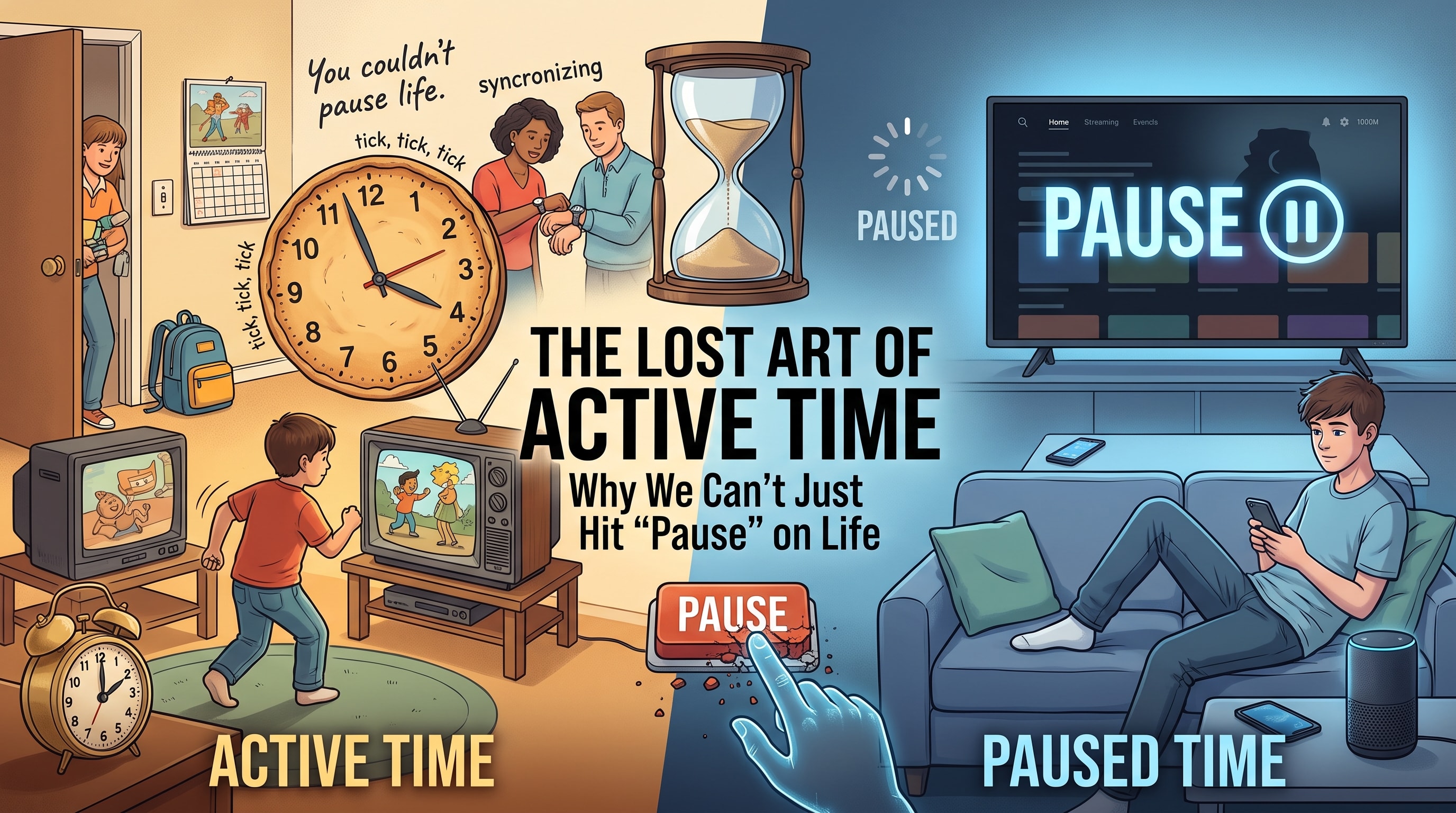
Recently, Isabel and I were having a conversation born out of a classic parenting frustration: trying to get the kids out the door.
I had woken my son up at 9:15 AM and told him we needed to be on the road by 10:00. That's 45 minutes to get moving. Yet, the dillydallying stretched right up to the very last minute, and we ultimately ended up leaving late.
It got me thinking about my own childhood and trying to analyze why, at that age, I seemed to be more on the ball when it came to managing the clock.
When I was in elementary school, I had a very strict morning routine. I had a 15-minute walk to school, and the doors opened exactly at 8:15 AM. But the real anchor of my morning was Heathcliff. The cartoon aired every day at 7:30 AM and ended at 8:00. I wanted to watch it before I went out the door, which meant I had to do the math: I needed to wake up, eat breakfast, and be fully dressed and ready to go before 7:30. If I wasn't ready, I missed the beginning of the show. And once the credits rolled at 8:00, I was out the door.
Today, this generation can simply stop time. If you're watching a show and need to leave the room, you hit pause. When I was a kid, you couldn't pause life. If I wanted to watch the Detroit Lions on Monday Night Football, my homework had to be done completely beforehand. You couldn't just start the broadcast at your convenience. It started when it started.
Even if you weren't fully ready for bed when an 8:00 PM movie began, you had to use the commercial breaks to brush your teeth and get into your pajamas. You had to move quickly, efficiently, and strategically because those commercials were short. Take too much time, and you'd miss the plot.
Because we didn't have devices automatically tracking and syncing time in the background, time required our active participation. We all wore watches. Today, we live in a society where watches are not as common as they used to be because people just look at their phones. That said, I think there is something about looking at an analog watch or clock that not only helps you track time, but the "giant pie"—as my friends and I called it—allowed us to understand fractions.
We had to be highly cognizant of keeping those watches synchronized, often calling the operator to get the official time to adjust the hands when batteries drained or springs wound down. Later, during my days as an officer in the Army, this habit carried over; we would frequently synchronize our watches before an operation. We respected the clock because the clock wasn't going to wait for us.
Time was also something you could hear and feel. In third grade, I had this annoyingly loud clock where you would hear the loud "tick, tick, tick" for each second. It unintentionally served as a metronome that helped me keep the time. Today, even without a watch, I can sense how much time has gone by.
Technology has given us incredible conveniences, but the ability to pause our media has subtly created an illusion that we can pause time itself. Time used to be a shared, flowing current we had to navigate actively. Now, it's something we treat as if it can be buffered.
We can pause a screen, but we can't pause the day. Maybe it's time we start teaching the next generation how to actively participate in time once again.